
The Internet on Autopilot
AI wants to make your Internet boring.
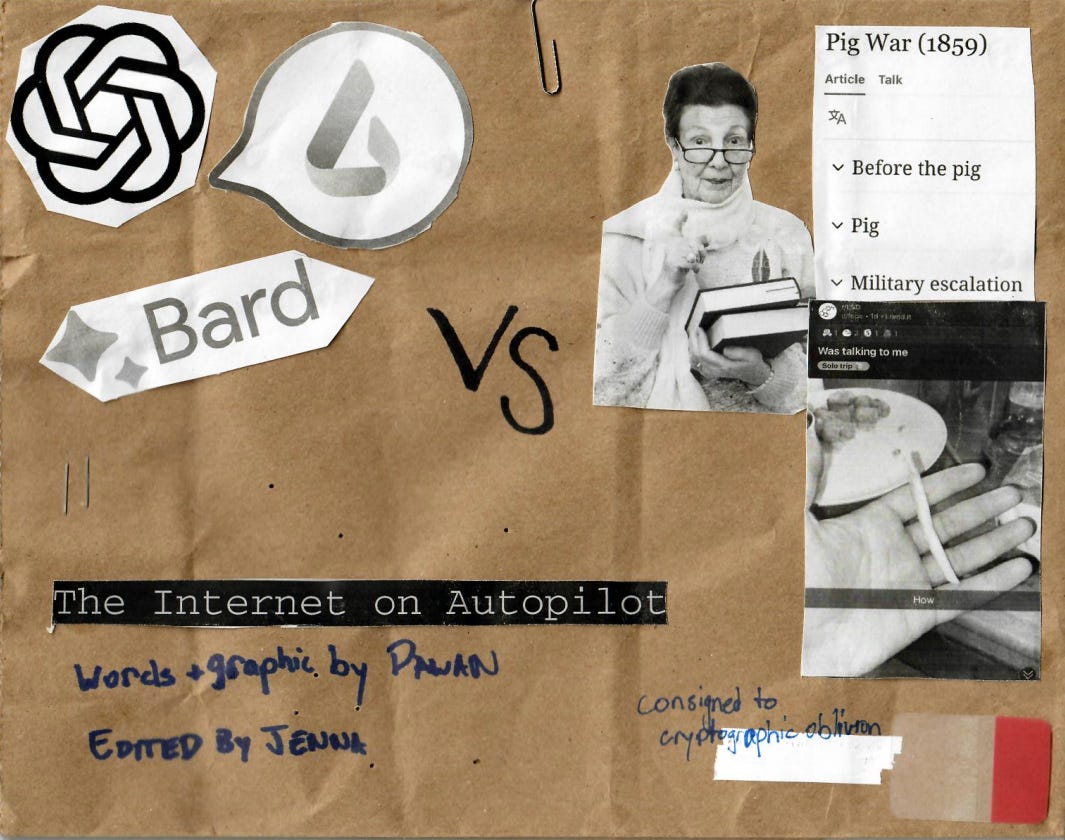
When ChatGPT came out, we saw the usual PR schemes and media attention afforded to Big Tech — this makes it difficult to tell if large language model (LLM) tools will go the way of Google+ or Google Search.
What we do know is synthetic text generators haven’t yet been sent to a farm up north. Instead we’re seeing Silicon CEOs brought to the highest offices of the wealthiest countries, delivering their takes on how to regulate against so-called ‘existential threats.’
Beyond governmental attention, we’re seeing increased consumer buy-in on large language models too, as Google, Microsoft, Zoom, and Will.i.am offer their brand of plug-in. Whether in the name of productivity or protection, people are purchasing these promises. Why?
Summarizing, condensing, bite-sizing. These are verbs any two-bit LLM will deploy to get your keystrokes and situate themselves as the one-stop shop for all your online information needs. I argue that the current genre of LLM-based ‘AI’ is trying to supervise your experience of the Internet. To explore that end, we must ask,
What will LLMs do to our Internet?
Blue light blindfolds
If synthetic text generators become core to our online experiences, situated as base functionality for sites of a certain size, what happens to the content they consume? The content you post? Sure, our current corporate LLMs feature citations and the tech corps insist that they’ll just provide snippets from the referenced material but I believe that won’t last. Just look at Google.
Type a common query into Google Search and it’ll likely show you one of its ‘knowledge panels’ comprising data skimmed off Wikipedia, news articles, even forum posts. SemRush analysis indicates that, for May 2022, about 20–25 per cent of Google searches were ‘zero-click,’ meaning the user did not click on a link. That could be because SEO, titling, and snippets are plenty informative but in my personal life, I’m finding those floating boxes to be ever-more encompassing.
This represents Google’s monopolistic encroachment onto other people’s work — Google’s not just cataloguing links, it’s scraping content. Why should we expect that to change when it comes to LLMs?
What’s to stop the next web-enabled GPT from having an increased word count and providing a more comprehensive summary to your question? What if you never click on a citation to see from what it’s pulling?
To take one more step, what if we see tech marketing pivot from making you want to use an LLM to insisting that the Internet needs LLMs?
The pitch could go like this: as we see greater saturation of the Internet with vapid, hollow LLM-generated text, the savvy consumer needs their own, personal LLM to cut through that noise. Like your Gmail-approved spam filter or your Google Translated Rosetta Chrome, entrust us to extract all that is necessary from that query you typed in. You don’t even have to switch tabs, we’ll serve up this world’s content from the comfort of a clean, minimalist chat bot window.
This is a world where we consign swathes of information to cryptographic oblivion, doomed to be scanned once by a crawler and left by the wayside, leached of its explanatory powers and dismissed for its creative ones.
It’s the Internet on autopilot.
If we concede that our Internet has become so unwieldy that Codes of Conduct and content moderation be damned, put BingBot at the wheel, we will lose out on the exploratory dimension of the web.
Boldly go
It’s no secret I adore Internet exploration. That is why I’m so concerned when the key function of LLMs — BingChat, GPT, Bard, all the big ones — is to treat the Internet as one massive corpus, able to be bagged (without consent),tagged (by horribly underpaid Kenyans), and served up only if you ask the magic question. That sanitized, SparkNotes-type of information structure ignores what’s crucial: context.
I’m no sysadmin or archival wunderkind but having done online research for a while, I know how I find information, and that’s through the library, Wikipedia, and the comments section.
The library has no algorithm, no ‘People also bought’ kickbacks, and crucially, a book is physically situated in context, inextricable from neighbouring knowledge in its Dewey-ordained ordinal.
I need to write a standalone on Wikipedia but suffice to say it has dug innumerable rabbit holes into which my friends and I happily fall. It still deserves deep scrutiny, particularly when Nazi hagiographies run amok, but it’s proven its lasting educational capacity.
By ‘comments section’ I mean catchall. When the sponsored and the clickbait overwhelms your Google Search, you affix “reddit” to your query. When a terrible YouTube tutorial is anchored by a comments section so lush it puts Oxford to shame. And, most revered, when the modern Internet user treads the path of their ancestor and finds their sibling-in-distress posting an identical problem, years ago.
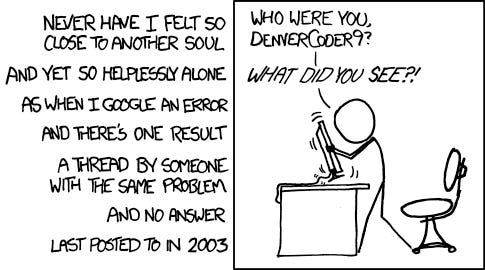
This realm of discovery is where the Internet’s real magic lies. This same realm is doomed if we believe the web is so unruly that navigation without your reductive robot companion is unfeasible.
And it shouldn’t be left as subtext: even without LLMs, the Internet is an expanding ocean of information that no one could ever chart. (Exemplifying this, a mesmerizing, incomprehensible livestream of every post made to Twitter clone Bluesky by its ~800k users.) This vastness is, of course, a natural product of the Internet’s accessibility — it’s a feature, not a bug.
We navigate this deluge by more consciously engaging with and curating our web, not by letting a necromantic hammer determine what exactly is a nail.
Coda
As mentioned at the beginning, I don’t know where LLMs go from here. It seems daily that they gain saturation of our information and communication technologies and I’ve yet to see a horizon on that. Yet.
If they stick around they’ll represent a paradigm shift for everyone engaging with the Internet, even those of us who yell at clouds. Don’t let them take away your online adventures.
If I’m wrong about all else, let this serve to reinvigorate your Internet odyssey into parts unknown. I hope you go find some fun, forgotten webpages.